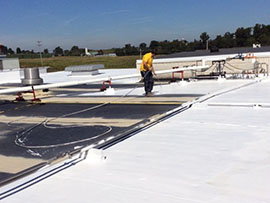
Commercial roof restoration can be a practical alternative to replacement when the existing roof is still a suitable candidate. For a Fallbrook, CA building, that decision should come from the roof’s actual condition, not from age or a coating sales pitch alone. Woolbright’s Roofing & Construction currently lists commercial roofing restoration among its services. To discuss a roof restoration assessment, call (951) 609-1818.
Energy Efficient Roofs
Reflective roof coatings can reduce solar heat absorption at the roof surface, which may help reduce cooling demand in some buildings. The actual effect depends on the existing roof color and reflectivity, insulation, HVAC performance, occupancy, local weather, roof area, and the coating system selected.
That means a restoration proposal should not promise a fixed utility savings figure. A more useful question is whether the proposed coating meets the building’s roof-system needs and whether any energy-related benefit is supported by the selected product data and the property’s actual conditions.
Spend Less!

Restoration can avoid some of the tear-off, disposal, and replacement work involved in a full reroof when the existing assembly remains serviceable. That can make restoration worth evaluating, but it does not automatically mean every coating project will cost less than every replacement. Roof size, access, preparation, repairs, moisture conditions, material requirements, and the selected system all affect the final scope and price.
Before a coating is approved, the roof should be evaluated for conditions that could prevent reliable adhesion or leave damaged materials trapped below the new surface. Important prerequisites include the moisture condition of the roof assembly, the stability and attachment of the existing membrane or substrate, the condition of seams and flashing, drainage performance, previous repair areas, and any visible deterioration that must be corrected first.
Moisture evaluation should use a method appropriate to the existing roof system and the question being investigated. Visual findings alone do not establish whether insulation or other concealed materials are dry. If the condition below the surface is uncertain, additional testing may be needed before the restoration scope is finalized.
Adhesion and product compatibility also matter. The selected coating must be approved for the existing surface, and the required cleaning, primer, repairs, reinforcement, application conditions, and coverage should follow the coating manufacturer’s written instructions. An adhesion check may be appropriate where required by the product or substrate, but the exact acceptance method should match the proposed system rather than rely on one universal field test.
A coating is not a substitute for correcting wet insulation, deteriorated decking, unstable substrate, unresolved active leaks, or other conditions that fall outside the restoration system’s limits. If those conditions are found, the contractor should explain the repairs or other roofing work that must happen before restoration can be considered, or why replacement may be more appropriate.
When the roof qualifies, restoration creates a renewed protective surface over the prepared existing roof. Application may involve multiple passes, reinforced details, primers, or other components depending on the selected system. Project timing depends on preparation, repairs, roof size, access, weather, cure requirements, and the manufacturer’s application conditions, so a coating project should not be described as automatically quick or simple.
Future recoating may be possible on some restored roofs, but it should not be promised in advance. Before another coating cycle, the roof must still be evaluated for moisture, substrate condition, adhesion, drainage, compatibility, and the requirements of the new restoration system.
Why Woolbright’s?
Woolbright’s Roofing & Construction currently provides residential and commercial roofing services in Southern California and lists restoration, repair, replacement, inspection, and maintenance among its roofing services. Its current site also lists more than 37 years in business. Those facts are more useful to a building owner than unsupported claims that any contractor is automatically the top option for every project.
For a commercial restoration proposal, ask for the findings behind the recommendation. The written scope should identify the existing roof system, areas requiring repair or preparation, the coating or restoration system being proposed, product-specific requirements, and any conditions that would cause the scope to change.
Call Us Today!
Call for Information
For commercial roof restoration in Fallbrook, CA, contact Woolbright’s Roofing & Construction at (951) 609-1818. The most useful next step is a condition-based assessment that confirms whether the roof is suitable for restoration and documents any repairs, moisture concerns, preparation, compatibility requirements, and acceptance criteria before work begins.
Frequently Asked Questions
Is every commercial roof a good candidate for restoration?
No. Restoration depends on moisture condition, substrate and attachment, seams and flashing, drainage, compatibility, and whether the existing roof can meet the selected system’s requirements.
How should moisture be checked before a roof coating?
The method should fit the existing roof system and the condition being investigated. If visual findings are not enough to establish what is below the surface, additional testing may be needed before the scope is approved.
Will a reflective roof coating lower my utility bills?
It may reduce solar heat absorption, but actual energy effects depend on the roof, insulation, HVAC system, occupancy, climate, and selected product. A fixed savings amount should not be assumed.
Can a restored roof always be recoated later?
No. A future coating cycle still depends on the roof’s moisture, substrate, adhesion, drainage, compatibility, and condition at that time.