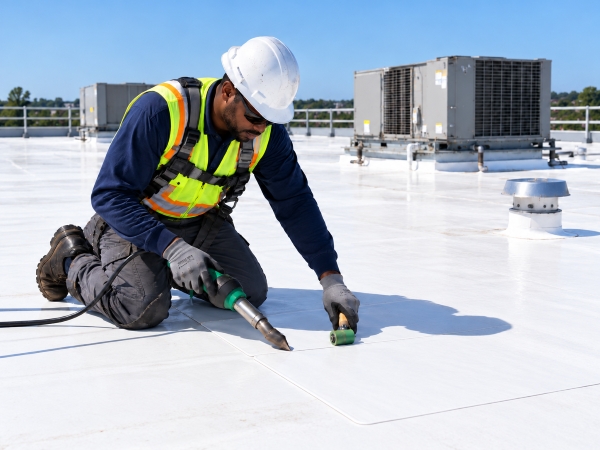
A commercial flat roof that leaks or holds water needs a repair matched to what is actually failing, not a quick patch over a stain. Woolbright’s Roofing & Construction repairs flat and low-slope commercial roofs for building owners and property managers in Canyon Lake, CA, and has served Southwest Riverside County and the Temecula Valley since 1988, with more than 37 years in the roofing industry.
This guide explains why flat roofs leak, which problems are usually repairable, how repairs differ by roof type, and when a repair stops being the right answer. If you already have an active leak, call us at (951) 609-1818 to schedule an inspection of your building.
Why Flat Roofs Leak

Flat roofs are not perfectly flat. They have a slight slope toward drains, scuppers or edges, and that low pitch is the main reason they are prone to ponding water. Water that remains after a storm can indicate a drainage or low-area condition, and recurring standing water can add stress to seams, flashing and the membrane surface. Over time it can contribute to cracking, blistering and tears, and debris that collects in low spots can add to the wear.
Canyon Lake commercial roofs can be exposed to strong sun and temperature changes that reveal existing weaknesses in membranes, sealants and flashing. Those conditions do not prove a specific failure, so the repair scope should follow what is actually observed. Once a leak starts, damage often extends beyond the roof. Wet insulation, stained ceilings and disrupted operations can follow, which is why a leak is better handled early than after the next storm.
Where the Leak Usually Starts
A stain on an interior ceiling shows that water got in, but it does not show where it entered. Water can travel along the deck or through insulation before it appears below, so the source is rarely directly above the stain. Several common roof details deserve close inspection, shown below.
| Likely Source | What It Can Look Like | Typical Repair Direction |
|---|---|---|
| Open or separated seams | Lifted edges, gaps or loose laps where roofing sections meet | Repair, reseam or patch with materials compatible with the existing roof and observed condition |
| Penetrations | Cracked sealant or worn boots around pipes, vents, drains and rooftop units | Repair or rebuild the flashing detail as needed for the installed roof system |
| Flashing and edges | Pulled-away or cracked flashing at parapet walls, curbs and perimeter edges | Repair or replace affected flashing and termination details as the condition requires |
| Ponding and drainage | Water that lingers after rain, clogged drains, debris, algae or dirt rings | Evaluate drainage separately, then repair any confirmed membrane or flashing damage |
| Membrane damage | Punctures, cracks, blisters or worn spots from foot traffic, debris or age | Patch isolated damage; widespread wear may call for a larger scope |
Finding the real source takes an inspection of the roof surface and its details, done by trained technicians with the right access equipment. Walking a commercial roof without that training is not a safe way to check.
Repairs by Roof Type
Repairs have to match the system on the roof, because different flat roof materials are patched and joined in different ways. Repair materials and methods need to be compatible with the installed roof, so identifying the roof type and condition comes first.
| Roof Type | Common Repair Methods | Compatibility Note |
|---|---|---|
| Modified bitumen | Repair laps, flashing or damaged areas with materials and methods compatible with the installed modified bitumen system | Asphalt-based repairs need compatible adhesives and surfacing |
| Built-up roofing (BUR) | Repair damaged plies, flashing or localized surface defects as appropriate for the existing BUR assembly | Layered construction means moisture can travel between plies |
| TPO and PVC | Use a repair method compatible with the installed TPO or PVC membrane, which may include welded patches or seam work where the system allows | TPO and PVC are different materials and are not generally interchangeable |
| EPDM | Use compatible EPDM repair materials and preparation methods specified for the installed system | EPDM repair methods differ from heat-welded TPO and PVC systems |
If you are working with a single-ply roof, our guides to single-ply roof repair in Canyon Lake and PVC roof repair in Canyon Lake go into those membranes in more detail.
What to Do When a Leak Appears
Protect people, equipment and inventory first. Move items away from the leak, contain dripping water and photograph the damage, noting when and where it appears and how heavy the rain was. Stay off the roof and call a contractor. Those notes help the inspector narrow down the source, especially when the leak only shows up in certain conditions.
When Repair Is Not Enough
A localized repair may fit when the defect is limited and the surrounding roof remains serviceable. If moisture, deterioration, substrate damage or repeated failures extend across broader areas, a larger repair, restoration or replacement scope may need to be compared instead of assuming another patch will be enough.
- If the membrane is aging but the roof is dry and sound, a coating may be an option, as covered in our guide to commercial roof restoration in Canyon Lake.
- If wet insulation, damaged decking or broad deterioration is confirmed, flat roof replacement may belong in the comparison.
- Roof maintenance and a commercial roof inspection can help document changes in condition, drainage and repair areas over time.
What a Flat Roof Repair Quote Should Include
A clear proposal names the roof system, the specific areas being repaired, the repair method and materials, and any flashing or drainage work. It should explain how roof access will be handled and how the work will be scheduled around an occupied building. Ask how hidden conditions are handled as well. If wet insulation or damaged deck is found once the roof is opened, the proposal should explain how added scope, documentation and approval will be handled before extra work proceeds.
Flat Roof Repair in Canyon Lake
Woolbright’s Roofing & Construction handles commercial flat roof repair, maintenance and inspection for Canyon Lake buildings. We can inspect the roof, identify the roof type, explain what we find and put the repair scope in writing. Call us at (951) 609-1818 to set up a visit.
Frequently Asked Questions
How do I know if my flat roof can be repaired instead of replaced?
It depends on how widespread the damage is. Localized problems such as a separated seam, failed flashing or a puncture may be repairable when surrounding materials remain suitable. Moisture spread across a wide area or wear across the whole roof may point toward a larger scope, and an inspection confirms which applies.
Why does my roof leak only when it rains hard?
Some defects become noticeable only during heavier rain, wind-driven rain or changing drainage conditions, but the actual source still needs to be confirmed on the roof. Notes on when the leak appears help an inspector find the source.
Can a flat roof be repaired in any weather?
Not always. Many repair materials require specific surface, temperature and moisture conditions. If those conditions are not available, the contractor should explain what temporary protection, if any, is appropriate and when the permanent repair can be completed.
Is it safe to look for the leak on the roof myself?
No. Commercial roofs have fall hazards, hidden weak spots and slick surfaces. Inspections should be done by trained technicians with proper access equipment.