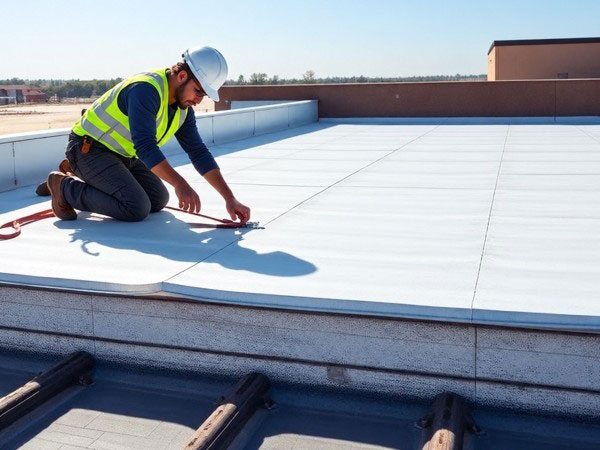
A commercial roof problem in Homeland, CA should be scoped from the roof’s actual condition, not from one visible symptom. Interior staining, membrane damage, ponding, flashing defects, or a recurring leak can all justify an inspection, but none of them alone proves how large the repair needs to be.
Woolbright’s Roofing & Construction provides commercial roofing services throughout Southwest Riverside County and the Temecula Valley. Property owners can call (951) 609-1818 to discuss a roof concern and the information needed for a condition-based repair scope.
Start With the Symptom, Then Find the Cause
Ceiling stains, damp materials, musty odors, visible membrane damage, loose flashing, or standing water can all signal that a roof needs attention. These are useful observations, but they are not a diagnosis.
Water can travel within a roof assembly before it becomes visible inside the building. A repair evaluation should trace the likely entry point and review the surrounding membrane, seams, flashing, penetrations, drainage, roof edges, and previous repairs before a scope is written.
Localized Damage May Support a Targeted Repair

A repair may be appropriate when the defect is limited to a defined area and the surrounding roof remains suitable for repair. Examples can include one failed seam, a localized puncture, damaged flashing around a penetration, or a limited section of deteriorated sealant.
The contractor should still check whether similar defects appear elsewhere. What looks isolated from one vantage point can be part of a broader pattern once the roof is examined.
Know When a Broader Assessment Is Needed
A larger evaluation deserves consideration when leaks recur after prior repairs, similar failures appear across several roof sections, moisture is suspected beyond the visible defect, or the membrane and flashing show widespread deterioration.
Those conditions do not automatically require replacement. They mean the owner needs enough evidence to compare continued repair, restoration, and replacement based on the roof’s actual condition and remaining serviceability.
Moisture Investigation Should Match the Roof
If trapped moisture is suspected, the contractor should explain how that concern will be investigated. The appropriate method depends on the roof system, insulation, deck, weather conditions, and the areas being evaluated.
A moisture check should support the repair decision rather than become a generic checkbox. If wet insulation or deck deterioration is found, the written scope should explain what material needs removal or replacement and how far the affected area extends.
Drainage Problems Need Their Own Scope
Ponding or slow drainage can contribute to roofing problems, but coating or patching the membrane does not correct the cause of poor drainage. Blocked drains, scuppers, low areas, settlement, roof geometry, or damaged insulation can all play a role.
If drainage work is part of the repair, the quote should identify it. If the repair will not address the drainage condition, that exclusion should also be clear before work begins.
Repair Materials Must Match the Existing Roof
Commercial roofs can use different membranes and repair methods. TPO, PVC, EPDM, built-up roofing, coatings, and other systems are not repaired with one universal product or detail.
The repair method should be compatible with the existing roof and the specific defect. Woolbright’s roofing services overview describes its broader repair, inspection, maintenance, restoration, and low-slope roofing capabilities for commercial properties.
What a Proper Repair Scope Should Include
A written repair scope should identify the roof area being addressed, the observed defect, the proposed repair method, preparation, materials, flashing or sealant work, access, cleanup, and exclusions. It should also explain how additional damage discovered during the work will be documented and approved.
If insulation replacement, deck repair, drainage correction, or other related work may be needed, the proposal should state whether those items are included, carried as allowances, or excluded.
Ask What the Repair Is Expected to Accomplish
A contractor should explain whether the repair is intended to stop one identified leak, restore a flashing detail, correct a puncture, repair a seam, or address another defined defect. That makes it easier to evaluate the completed work and prevents a localized repair from being mistaken for a complete roof restoration.
If a warranty is offered, ask what applies to the repair work itself and what remains outside that coverage. The written warranty terms should control rather than a general verbal promise.
Verify the Contractor and Project Documentation
Before hiring a contractor, confirm current licensing, bonding, insurance, and experience with the roof system involved. Woolbright’s current site identifies the company as fully licensed, bonded, and insured and states that it has provided residential and commercial roofing services since 1988.
Its About page also documents the company’s history in Southwest Riverside County and the Temecula Valley. Those facts can be part of a contractor comparison, but the repair recommendation itself should still stand on the inspection findings and written scope.
Commercial Roof Repair in Homeland, CA
For a Homeland commercial property, the useful question is whether the observed defect is truly localized, whether the surrounding roof remains repairable, and whether the quote clearly explains what will be fixed and what remains outside the scope.
Call Woolbright’s Roofing & Construction at (951) 609-1818 to discuss a commercial roof inspection or repair evaluation for your Homeland building.
Frequently Asked Questions
What are common reasons a commercial roof needs repair?
Localized seam failures, punctures, flashing defects, drainage problems, and damage around penetrations are common repair triggers, but the cause should be confirmed before the scope is set.
How do I know if the roof needs repair or replacement?
That depends on the extent of damage, moisture conditions, repair history, membrane condition, deck and insulation condition, and whether the remaining roof is still suitable for repair.
How long does a commercial roof repair take?
There is no universal timeline. Repair size, roof system, access, weather, drying or cure requirements, and any discovered damage can all affect the schedule.
What should a commercial roof repair quote include?
It should define the repair area, observed defect, repair method, materials, preparation, related flashing or drainage work, exclusions, cleanup, and how additional damage will be handled.