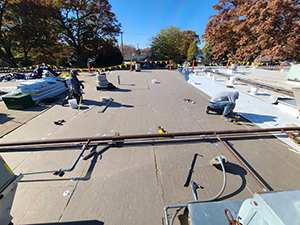
Beaumont sits on the I-10 corridor between the Inland Empire and the Coachella Valley, and the distribution centers, logistics facilities, and large commercial buildings lining that stretch have a roofing problem in common: massive flat roof surfaces exposed to triple-digit summer heat and rapid thermal cycling. A TPO roofing system handles those conditions better than most alternatives, and at Woolbright’s Roofing & Construction we install and service TPO across SW Riverside County. Call us at (951) 609-1818 to schedule an inspection.
This article covers why TPO is the system Beaumont’s warehouse and distribution buildings keep coming back to, how the installation process works on a large commercial footprint, and what building owners need to know about keeping a TPO system performing long term.
TPO Roofing System Works Best for Warehouses
The I-10 logistics corridor through Beaumont has some of the largest flat roof footprints in Southern California. A 500,000-square-foot distribution center generates enormous thermal load on its roof assembly every summer, and the surface temperature swings between night and day in the high desert can exceed 60 degrees in a single cycle. TPO membranes are formulated for exactly this. The white reflective surface redirects solar energy rather than absorbing it, cutting surface temperatures significantly and reducing the cooling load on the HVAC systems that run continuously through California’s long summer season.
Heat-welded seams are the other reason large commercial buildings in the Inland Empire default to TPO. On a building with thousands of square feet of roof area, a properly welded TPO seam creates a bond stronger than the membrane itself. There are no exposed fasteners to fail, no lap seams to lift, and no points where water can find its way in between sheets. For a building running active operations that cannot afford a leak event, that reliability matters more than almost any other specification.
How a TPO System Is Installed on a Large Commercial Building

A professional TPO installation on a large Beaumont commercial building follows a defined sequence that most building owners never see. The deck is inspected first, and any damaged sections are addressed before insulation goes down. Rigid insulation boards are mechanically fastened or adhered to bring the assembly to the required R-value, which in California’s Title 24 environment is a compliance requirement, not a suggestion. TPO membrane rolls are then unrolled, positioned, and heat-welded at every seam using calibrated hot air equipment.
Penetration detailing is where quality separates from average on a large commercial roof. HVAC curbs, exhaust fans, drains, and conduit penetrations all require individual flashing details that are welded into the field membrane. On a distribution center with dozens of rooftop units, that work takes time. A contractor who rushes penetration detailing is the reason TPO roofs leak at HVAC curbs within the first few years. Getting it right the first time is the only outcome worth accepting.
TPO Roofing System Thickness and Why It Matters
TPO membranes come in 45-mil, 60-mil, and 80-mil thicknesses. On a warehouse or distribution building where service technicians access the roof regularly to maintain HVAC equipment, membrane thickness determines how well the surface holds up to that foot traffic over time. A 45-mil membrane is the thinnest available and the least appropriate for high-traffic commercial applications. Most Inland Empire commercial buildings are better served by 60-mil as a baseline, with 80-mil the right call on buildings with heavy rooftop equipment or frequent service access.
A contractor who proposes 45-mil across the board regardless of building use is optimizing for material cost, not building performance. The difference in installed cost between membrane thicknesses is modest compared to the difference in service life on a building that sees real-world rooftop use.
Keep Your Beaumont Warehouse Running with the Right TPO Roofing System
Distribution centers, retail buildings, and commercial facilities along the I-10 corridor in Beaumont, CA need a roof system built for California’s heat and designed to last. At Woolbright’s Roofing & Construction, we install TPO systems on commercial buildings across SW Riverside County with the detailing and warranty backing to make them perform. Call us at (951) 609-1818 and let us take a look at what your building needs.
FAQ
Does a TPO roofing system qualify under California’s Title 24 energy code?
Yes, white TPO membranes meet Title 24 cool roof requirements for low-slope commercial buildings in most California climate zones.
How long does a commercial TPO roofing system last in the Inland Empire’s heat?
A properly installed TPO system with a quality membrane typically delivers 20 to 30 years of service life in Southern California conditions with basic periodic maintenance.
Can a TPO roofing system be installed over an existing flat roof membrane?
In some cases yes, but local building code limits the number of existing roof layers allowed before a tear-off is required, so a proper inspection must come first.
Is TPO compatible with rooftop solar installations common on Beaumont warehouse buildings?
Yes, ballasted solar racking systems work well on TPO roofs, and penetration-based mounts can be installed with proper flashing details.