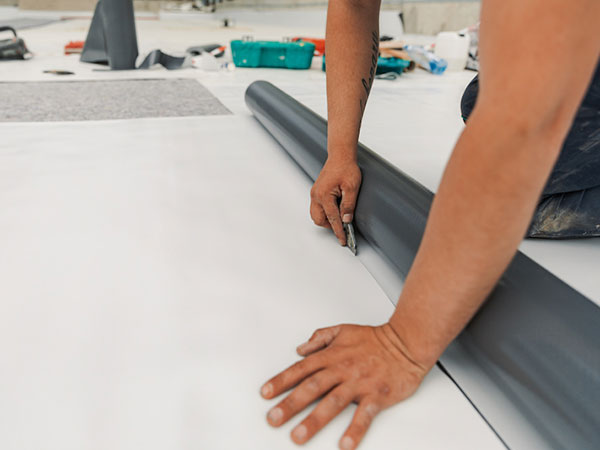
Buildings across San Jacinto face the same low slope roof problems every summer. Aging membranes lose their grip, reflective surfaces fade, and adhesive seams leak in the same spots after every repair. A TPO roof installation solves several of those problems at once when the underlying substrate is sound. Call Woolbright’s Roofing & Construction at (951) 609-1818 for TPO roof installation in San Jacinto, CA.
4 Problems That Push Owners Toward TPO Roof Installation
Four problems drive most valley buildings toward a new membrane. First, an aging membrane that has been repaired too many times to justify another patch. Second, a reflective surface that has faded to gray and is driving summer cooling loads higher than they were five years ago. Third, seam failures that keep opening back up after repair. Fourth, an existing system that never suited the thermal demands of San Jacinto to begin with.
TPO roof installation addresses all four. The following sections walk through each problem and the specific installation mechanism that solves it, so an owner can match the problem set on their roof to the right fix.
The Aging Membrane Problem, and the TPO Roof Installation Fix
An aging membrane hits a point where repairs cost more than they extend the roof’s life. Adhesive bonds have failed in enough places that patching one opens another. Insulation is starting to hold moisture in localized zones, which accelerates the next round of failure.
A TPO roof installation replaces the membrane and, when the moisture scan supports it, the wet insulation underneath. The new heat-welded seams eliminate the adhesive bond points that were the failure pattern on the old roof. From day one the roof carries a fresh warranty and a fresh service clock. The owner stops spending on repairs that no longer buy time.
The Reflectivity Problem That TPO Roof Installation Solves

A dark or faded roof surface pulls solar energy in and hands it down through the assembly as heat. In San Jacinto that shows up on the utility bill as longer HVAC runtime and higher summer cooling bills every year the surface degrades further.
A new TPO roof installation goes down bright white and stays reflective for years. Surface temperature on a fresh white TPO drops significantly compared to an aged dark membrane. That reflectivity carries through the roof assembly as lower plenum and attic temperatures, and the HVAC system cycles less to hold the setpoint below.
Seam Failures the Old Roof Cannot Stop
Seam failures are the most persistent problem on any adhered membrane. Repairs address the specific opening but not the mechanism, so the next failure shows up nearby. On an older membrane with adhesive seams, the pattern repeats until repair costs justify replacement.
Heat-welded seams fuse the top and bottom sheets into a single continuous surface. There is no adhesive bond to age out. The seam is as strong as the sheet itself. That is why heat welding is the standard mechanism for solving the seam-failure problem at the source.
A TPO Roof Installation in San Jacinto Solves the Right Problems
The mechanism works only when the deck and insulation are sound or replaceable. A moisture scan, a seam-by-seam inspection, and a review of repair history confirm a new membrane is the right response to the problems documented.
For TPO roof installation in San Jacinto, CA, contact Woolbright’s Roofing & Construction at (951) 609-1818 today.
FAQ
Can TPO be installed over an existing roof?
Often yes, when the existing membrane is dry, adhered flat, and code allows a re-cover. When the roof already carries two layers or shows saturated insulation, a full tear-off is required.
How long does a TPO roof last in San Jacinto’s heat?
A properly installed TPO roof runs twenty to thirty years in the valley climate. Membrane thickness at install and the quality of the seam welds drive the top end of that range.
How long does a full TPO roof installation take on a commercial building?
Most valley projects run one to three weeks depending on square footage, tear-off scope, and how many rooftop penetrations need reflashing.