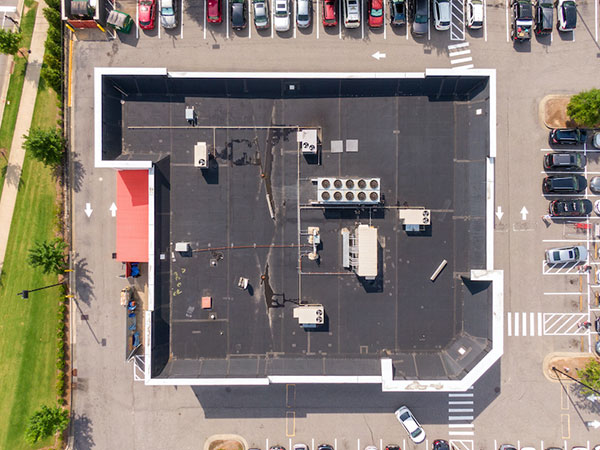
The San Jacinto Valley runs long, hot summers with sustained UV and short, concentrated rain events in the wet season. Both are hard on a commercial roof. Choosing the right low slope roofing system comes down to membrane type, substrate condition, and how the roof performs under both extremes. Call Woolbright’s Roofing & Construction at (951) 609-1818 for low slope roofing in San Jacinto, CA.
Three Low Slope Roofing Systems Fit San Jacinto Buildings
Three system categories are worth serious consideration for a valley building. Single-ply membranes like TPO, EPDM, and PVC dominate the commercial market. Spray polyurethane foam is a seamless option that adds insulation and shape. Roof coating systems applied over an existing membrane renew a roof that is still structurally sound.
Each handles heat, UV, and heavy rain differently. Each fits a different substrate condition and a different owner tolerance for downtime. The rest of this comparison walks through how each system responds to San Jacinto’s climate so a property owner can weigh trade-offs without picking a winner in advance.
Single-Ply Low Slope Roofing in Valley Heat

Single-ply membranes are the most common low slope roofing choice in Southern California. TPO installs with heat-welded seams and delivers a white reflective surface that handles UV and summer heat well. EPDM is a black rubber membrane that stands up to thermal cycling but absorbs heat, which raises cooling loads. PVC uses chemically welded seams and holds up longer than TPO against animal fats and chemical exhaust.
For a valley warehouse or retail building with clean rooftop conditions, TPO is often the starting recommendation. PVC steps in when exhaust chemistry rules TPO out. Each option comes off the roll in a defined thickness, so install goes fast on large flat expanses.
Spray Foam Delivers a Seamless System
Spray polyurethane foam is applied as a liquid that expands and cures into a solid layer bonded to the substrate. That single mechanism handles three problems at once. It creates a monolithic waterproof surface with no seams. It adds insulation across the entire roof plane. And it self-levels into low spots, which addresses ponding without a structural taper.
Foam always gets a protective coating on top to handle UV. In San Jacinto’s sustained summer sun, that coating is where the reflective performance lives. A foam roof with regular recoat can serve fifty years or more without a full tear-off.
Coatings Extend an Existing Low Slope Roofing System
When the substrate under the current membrane is dry and sound, a fluid-applied coating renews the roof rather than replacing it. That means no tear-off, no landfill, and no interruption to the tenants below.
Coatings work best over aged single-ply, modified bitumen, and metal roofs that pass a moisture scan. The coating bridges seams, restores reflectivity, and adds ten to fifteen years to a roof that would otherwise need replacement. For a valley building where the concentrated rainy season leaves little installation window, a coating job fits the schedule single-ply cannot.
Choosing Between Low Slope Roofing Options in San Jacinto
The right choice is driven by substrate condition, rooftop exposures, cooling load priorities, and how long the owner plans to hold the building. A thorough moisture scan and a walk of the entire roof answer most of those questions.
For low slope roofing in San Jacinto, CA, contact Woolbright’s Roofing & Construction at (951) 609-1818 today.
FAQ
What is the difference between low slope roofing and a flat roof?
No commercial roof is truly flat. Low slope means the pitch is under 3 in 12, enough to move water toward drains but not enough to shed like a pitched roof.
Do low slope roofs need drains or scuppers in San Jacinto?
Yes. Every low slope roof needs positive drainage through interior drains or edge scuppers so concentrated valley rain does not pond and shorten membrane life.
How often should a low slope roof be inspected in Southern California?
Twice a year is the standard, once before the rainy season and once after. Rooftop equipment repairs or roof access work should trigger an extra look.