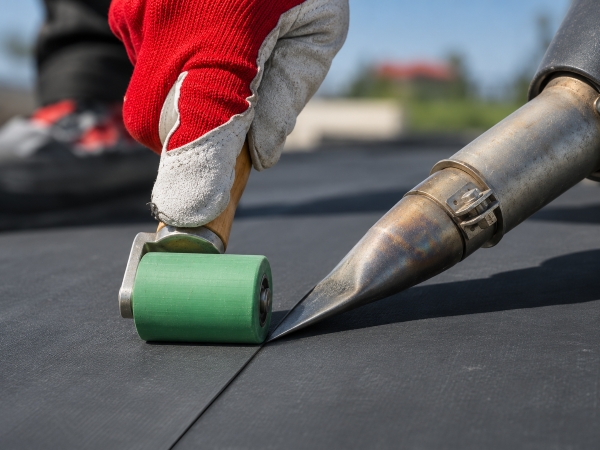
How is a commercial EPDM roof in Temecula, CA repaired, and when does it need more than a repair? EPDM leak investigations commonly focus on seams, flashing, penetrations, punctures and other membrane details. A targeted repair may fit when the defect is localized and the surrounding membrane, substrate and moisture conditions remain suitable. Broader deterioration or moisture involvement can require a larger scope.
Woolbright’s Roofing & Construction has served Southwest Riverside County since 1988 and works on commercial single-ply roofs, including EPDM. You can also read about our work in Temecula.
What EPDM Is and Why Repairs Differ From Other Single-Ply Roofs

EPDM is a rubber single-ply membrane supplied in large sheets. Depending on the roof assembly, EPDM may be ballasted, mechanically attached or fully adhered over a suitable substrate. Seams and details may use compatible tape, adhesives, flashing membrane or sealant according to the installed system.
That construction shapes the repair. Unlike heat-welded membranes such as TPO and PVC, EPDM seams are generally bonded with tape or adhesive, so a failed seam is generally repaired with compatible EPDM repair materials rather than a thermoplastic heat weld. Weathered EPDM generally requires preparation that meets the selected repair material’s cleaning, priming and adhesion requirements. Repair methods should follow the membrane manufacturer’s instructions for the specific product on the roof.
Common EPDM Problems and How They Are Repaired
The table lists common repair conditions and a general approach to each. The exact method depends on the roof’s age, attachment type and condition.
| Problem | What It Usually Looks Like | Typical Repair Approach |
|---|---|---|
| Seam separation | Open or lifting edges where membrane sheets meet, with or without related interior moisture symptoms | Prepare the seam and use compatible tape, primer, adhesive or other repair materials required by the installed system |
| Punctures and tears | Cuts or holes associated with traffic, tools, debris or other damage | Prepare the area and install a compatible membrane repair using the required primer, tape or adhesive |
| Flashing and penetration failures | Pulling, gaps or cracking at walls, curbs, pipes and rooftop equipment | Repair or replace affected flashing or termination materials and reseal details with compatible components |
| Membrane shrinkage | Membrane pulled tight at corners and edges, with tension at flashing | Evaluate the cause of tension and repair affected flashing, edge or membrane details as required |
| Ponding and weathering | Recurring standing water, weathered membrane or surface cracking that may indicate drainage or material concerns | Evaluate the drainage condition separately, then determine whether localized repair or a broader scope is appropriate |
Repair performance depends on proper surface preparation and compatible materials. The membrane should meet the selected repair material’s preparation and moisture requirements, and the repair should extend onto sound, compatible material as required by the repair system. Contamination, moisture, loose material or unsound edges can interfere with adhesion and repair performance.
Finding the Real Leak Source
Interior moisture does not necessarily identify the roof entry point directly above it. It can travel along the deck or through the insulation before it appears inside. The roof should be evaluated around the reported area, including seams, flashing, penetrations and drainage conditions, rather than assuming the visible stain identifies the exact source.
Moisture evaluation may help determine how far the problem extends. If wet insulation or other unsuitable materials are confirmed, the repair scope should address them before the membrane work is completed.
Repair or a Larger Scope?
A repair may fit when problems are localized and the surrounding membrane and assembly remain serviceable. The table compares the usual indicators.
| Condition | Repair May Fit When | A Larger Scope May Be Needed When |
|---|---|---|
| Leak source | The source is a located seam, penetration or small tear | Leaks keep returning in different places |
| Moisture | Moisture is absent or limited to an area that can be addressed within the repair scope | Moisture is broad enough to change the repair or restoration plan |
| Membrane | The surrounding membrane remains serviceable apart from the localized defect | The membrane shows broader cracking, deterioration or loss of serviceability |
| Seams and flashing | A few seams or details have failed | Seams and flashing are failing roof-wide |
| Drainage | Drainage is functioning without a recurring condition that changes the repair scope | Recurring ponding or drainage problems require a broader correction |
An aging EPDM roof can have a long service life, but there is no fixed number that fits every roof. Condition matters more than age alone. An inspection that documents the membrane, seams, flashing and moisture gives you the basis to decide between repairs, ongoing maintenance and a longer-term plan.
Inspection and Maintenance Support Repairs
Inspection and maintenance can help document changing EPDM conditions and identify new repair needs. Woolbright’s maintenance programs begin with an initial inspection of the roof assembly, flashing, terminations and rooftop equipment, and include yearly pictures and an overall inspection according to the client’s maintenance program description. See the maintenance programs page for what is included, or the roof inspection page for Temecula to understand how inspections are timed. Owners planning across the full life of a roof can also use roof asset management and lifecycle planning.
Questions to Ask Before Approving an EPDM Repair
- How was the leak source identified, and was moisture checked?
- What repair materials will be used, and are they compatible with the existing EPDM?
- How will seams, flashing and penetrations near the repair be handled?
- Will the repair be photographed and documented?
- What follow-up inspection or documentation is included after the repair?
Commercial roof access should follow the contractor’s and property’s safety procedures; owners can document interior symptoms without climbing onto the roof.
Frequently Asked Questions
Can a leaking EPDM roof be repaired?
Often, yes. A localized seam, penetration or small tear may be repairable when the surrounding membrane, substrate and moisture conditions remain suitable.
How are EPDM seams repaired?
Failed seams are generally prepared and repaired with compatible EPDM tape, primer, adhesive or other materials required by the installed system.
Why do EPDM roofs leak at the edges?
Edges, terminations, flashing and penetrations can be affected by movement, attachment and aging, and some EPDM systems can develop tension at corners or perimeter details.
When is repair no longer enough?
A larger scope may be needed when problems recur across multiple areas, moisture involvement is broad, or the membrane and surrounding assembly show widespread deterioration.