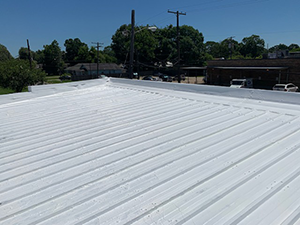
When is a commercial roof in Wildomar, CA a sound candidate for restoration, and when does coating stop making sense? Restoration works on a roof that is still fundamentally intact: dry, well bonded and structurally sound, with wear that can be repaired and sealed. It does not work as a cover for water that is already inside the roof or for a roof that has failed.
Woolbright’s Roofing & Construction has served Southwest Riverside County since 1988 and treats commercial roof restoration as a core service for Wildomar properties. To discuss a restoration assessment, call 951-609-1818. Our Wildomar commercial roofing page outlines the services available in the area.
Why Commercial Roof Restoration?
Restoration sits between spot repair and full replacement. Instead of fixing one leak at a time or tearing off the entire roof, the whole roof is inspected, damaged areas are repaired, the surface is cleaned, and a protective coating is applied over the existing roof. It suits roofs where damage is small but widespread, such as scattered seam wear, aging flashing and a weathered surface.

Compared with replacement, restoration generally involves less demolition and less disruption to a building that stays in operation, and it can extend the service life of a roof that qualifies. How much life it adds depends on the roof’s materials and condition, so treat any figure as an estimate to confirm after an inspection, not a promise.
Is the Roof a Restoration Candidate?
The decision comes down to a handful of conditions. The table compares them.
| Condition | Restoration Is Usually Reasonable When | Restoration Is Usually Not the Answer When |
|---|---|---|
| Moisture | Insulation and deck are dry, or wet spots are small and can be repaired first | Insulation is saturated across large areas, so a coating would trap water |
| Adhesion | The existing surface is clean and bonds well to the new coating after preparation | The surface is loose, flaking or delaminating and cannot hold a coating |
| Substrate | The membrane or surface is sound, with localized seam, flashing or puncture repairs | Decking is rotten or the roof system has failed broadly |
| Drainage | Water leaves the roof, or ponding is minor and its cause can be corrected | Ponding comes from a slope or drainage defect that a coating cannot fix |
| Compatibility | The coating is compatible with the existing roof type and any prior coatings | The existing material and coating cannot be matched, or the roof has several incompatible layers |
Two points are worth stating plainly. A coating does not correct ponding water caused by a drainage or slope defect, and it does not repair rotten decking or saturated insulation. Those problems have to be addressed first, or the roof is better served by repair or replacement.
What the Restoration Process Involves
A well-run restoration follows a sequence, and each step affects the next:
- Inspection. The roof assembly, flashing, penetrations, vents and rooftop equipment are reviewed, and moisture is checked where wet insulation is suspected.
- Repairs. Patching, seam repair, flashing and gutter work are completed before anything is coated.
- Cleaning. Dirt, debris and loose material are removed so the coating can bond.
- Coating. A protective coating, such as an acrylic or silicone system matched to the existing roof, is applied.
- Acceptance and follow-up. The finished surface is checked for coverage and details, and the roof goes on a follow-up inspection schedule.
Reflective coatings can lower the heat a roof absorbs, but the effect on cooling costs depends on the building, the roof and its insulation, so energy savings should not be assumed.
What to Ask Before Approving a Restoration
A restoration proposal should be specific about the roof in front of it. Before you approve one, ask how moisture was checked and where, which repairs will be made before coating, what coating system is proposed and why it suits the existing roof, and how the finished work will be accepted. Ask what the follow-up inspection schedule will be, because a coated roof still needs periodic checks of seams, flashing and drains. A proposal that skips these points, or that promises a fixed number of added years without inspecting the roof, deserves a second look.
Bring any past roof reports, repair records and warranty paperwork to the assessment. They help show what has already been done to the roof and whether earlier coatings or repairs affect what can go on top.
Restoration, Repair or Replacement?
If the problem is a single leak or damaged seam, targeted repair may be enough. For single-ply roofs, see our single-ply roof repair in Wildomar and single-ply roof maintenance pages. If the inspection finds widespread failure, wet insulation or structural damage, replacement is usually the better path. Owners planning across the life of a roof can also read about roof asset management and lifecycle planning.
Commercial Roof Restoration by Woolbright’s Roofing and Construction
Woolbright’s Roofing & Construction has provided roofing services in Southern California since 1988, and the company is licensed, bonded and insured. Its services include leak detection, repair, replacement, restoration, inspection and maintenance for commercial properties. A restoration assessment should leave you with a clear explanation of why the roof does or does not qualify.
Contact Us
If you own a commercial building in Wildomar, California and want to know whether restoration fits your roof, call Woolbright’s Roofing & Construction at 951-609-1818.
FAQ
How do I know if my commercial roof can be restored?
The roof generally needs to be dry, well bonded and structurally sound, with damage that can be repaired. An inspection with moisture checks confirms whether it qualifies.
Can a coating fix a leaking roof?
Only after the source of the leak is repaired. A coating does not correct drainage defects, rotten decking or saturated insulation.
What happens before the coating is applied?
The roof is inspected, damaged areas are repaired, and the surface is cleaned so the coating bonds properly.
How long does a restored roof last?
It depends on the roof’s materials, condition and the coating system used. An inspection can give a realistic estimate for your roof.