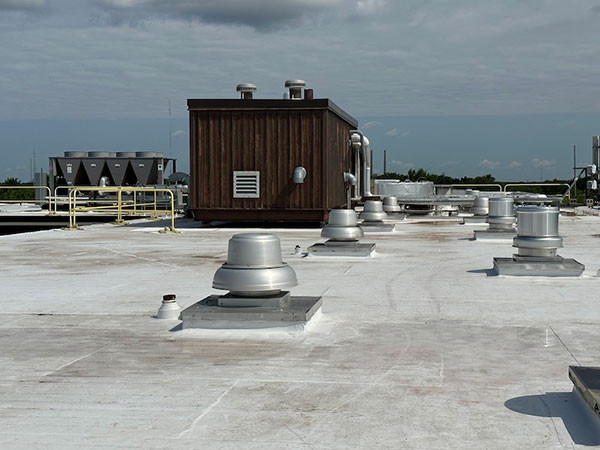
San Jacinto’s Inland Empire location exposes commercial roofs to sustained sunlight and heat, followed by rain during the cooler months. That cycle tests waterproofing details, and problems can start in places that are difficult to see from the ground. Commercial roof inspections focused on waterproofing give property owners a clearer understanding of the roof’s current condition and maintenance needs. Woolbright’s Roofing & Construction performs waterproofing-focused inspections on commercial buildings across the San Jacinto Valley. Call us at (951) 609‑1818 for commercial roof inspections in San Jacinto, CA.
Commercial Roof Inspections Reveal Waterproofing Failures
A roof leak inside a building indicates that water has passed through the roofing system. By the time a ceiling tile stains or a wall shows moisture, water may already have affected concealed roof components. A waterproofing-focused inspection can identify deteriorating roof details, potentially before water reaches the interior.
This distinction matters for property owners budgeting maintenance. A membrane seam starting to separate may need a localized repair. If water has entered through an open seam and saturated the insulation, affected roofing materials may need replacement. An inspection helps establish the condition of the roof and the extent of work needed.
The Waterproofing Details an Inspector Evaluates on a Commercial Roof

Membrane seams are a key focus. On single-ply systems, damaged or separated seams can allow water entry. The inspector evaluates accessible field seams and termination points for signs of separation or deterioration. The evaluation accounts for the membrane type, installation details, and observed condition.
Flashing at penetrations and perimeter edges receives the same attention. Every HVAC curb, pipe boot, vent stack, and parapet wall transition is a potential waterproofing weak point. The inspector checks the bond between the flashing membrane and the field sheet, the condition of sealant, and whether flashing has begun to crack or pull away. Drainage is evaluated alongside these components because standing water can increase exposure at vulnerable roof details.
What Inspection Findings Mean for Roof Performance
An inspection report that flags early seam separation or sealant failure gives property owners an opportunity to arrange repairs. Promptly addressing those findings helps maintain waterproofing and reduce the risk of secondary damage from water intrusion, including wet insulation, corroded decking, and mold in the building interior.
When an inspection suggests moisture is present below the membrane, further evaluation may be needed. Infrared scanning can help identify suspected wet areas, while core samples can help verify conditions within the roof assembly. Wet insulation can lose thermal performance, and affected materials may require removal and replacement. Establishing the extent of moisture before defining the repair scope helps property owners plan the work more accurately.
Commercial Roof Inspections Protect Investments Below the Membrane
The roofing membrane is the first barrier, but the investment also includes everything underneath it: the insulation, decking, interior space, and inventory or equipment below. Commercial roof inspections focused on waterproofing performance give San Jacinto property owners information they can use to plan repairs and protect the building. For commercial roof inspections in San Jacinto, CA, contact Woolbright’s Roofing & Construction at (951) 609‑1818 today.
FAQ
How often should a commercial roof be inspected in the Inland Empire?
Twice a year is the standard recommendation, once before the rainy season and once after. Buildings with older membranes or heavy rooftop equipment may warrant a third visit during the dry months to catch heat-related seam deterioration.
Does the extent of roof damage affect repair or replacement decisions?
The extent of damage is one consideration. The roof’s overall condition and applicable local requirements also need to be reviewed before deciding whether to repair, recover, or replace it.
What should a commercial roof inspection report include?
The report should include photographs of every finding, the location on the roof, a description of the condition, and a recommendation for each item. A useful report separates immediate repairs from items to monitor at the next inspection.