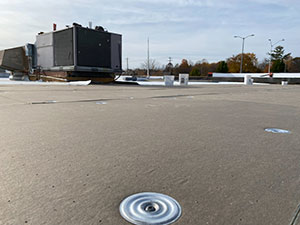
At Woolbright’s Roofing and Construction, we help commercial property owners in Banning, CA make informed decisions about a TPO roofing system. TPO, or thermoplastic polyolefin, is a single ply roofing membrane commonly used on flat and low slope commercial buildings. It is designed to provide durability, energy efficiency, and long-term weather resistance in demanding environments. Understanding how TPO works and where it performs best is essential for selecting the right roofing system. For professional evaluation or installation, contact Woolbright’s Roofing and Construction at (951) 609-1818, serving commercial properties throughout Banning, CA.
Roofing 101: TPO Systems
A TPO roofing system is a single ply membrane roofing solution made from a blend of polypropylene and ethylene propylene rubber. The membrane is manufactured in large sheets and installed in a continuous layer across the roof surface. Once installed, seams are heat welded together to form a watertight barrier.
TPO membranes are typically white or light colored, which allows them to reflect sunlight and reduce surface temperatures. The system is commonly used on commercial buildings because it balances durability, cost efficiency, and energy performance. Unlike traditional built up roofing systems, TPO creates a uniform membrane that limits weak points and simplifies long term performance monitoring.
Where is TPO Roofing Commonly Used?
TPO roofing systems are widely used across commercial and industrial properties in southern California due to their adaptability and performance characteristics.
Common building types that use TPO roofing include:
- Warehouses and distribution centers that require large uninterrupted roof surfaces
- Retail centers and shopping plazas where energy efficiency impacts operating costs
- Manufacturing facilities with rooftop equipment and frequent foot traffic
- Office buildings that need reflective roofing to manage interior temperatures
- Medical and institutional buildings that require reliable waterproofing
- Schools and municipal buildings focused on long term durability and maintenance control
For these buildings, TPO serves specific purposes. It protects large roof spans from UV exposure, manages heat gain, and creates a stable surface for rooftop equipment such as HVAC units. Its heat welded seams make it well suited for buildings that experience frequent temperature changes and sun exposure, which is common in Southern California.
Performance Characteristics

Environmental conditions play a major role in roofing system performance. In Banning, CA, roofs are exposed to high temperatures, intense sunlight, and seasonal weather shifts. TPO roofing systems are designed to perform under these conditions.
Key performance characteristics include:
- Heat Reflectivity: Light colored TPO membranes reflect solar radiation, reducing roof surface temperatures and helping stabilize interior building conditions.
- UV Resistance: TPO membranes are formulated to withstand prolonged UV exposure without rapid degradation.
- Flexibility: The material accommodates normal building movement caused by thermal expansion and contraction.
- Seam Strength: Heat welded seams create strong, consistent bonds that reduce leak potential over time.
- Puncture Resistance: Properly installed TPO resists damage from foot traffic and rooftop equipment maintenance.
These characteristics make TPO suitable for commercial roofs that must perform consistently in warm climates while minimizing energy strain on the building.
How a TPO Roofing System is Installed
A TPO roofing system is only as effective as its installation. Professional installation follows a structured process designed to ensure long term performance.
The process typically includes:
- Roof Evaluation: Assessing the existing roof structure, insulation, drainage, and substrate condition.
- Surface Preparation: Cleaning and preparing the roof deck to ensure proper membrane adhesion or attachment.
- Insulation Installation: Installing insulation boards to improve thermal performance and create a smooth surface.
- Membrane Placement: Rolling out TPO sheets and positioning them according to the roof layout.
- Attachment Method: Securing the membrane using mechanical fastening, full adhesion, or a hybrid method based on building design.
- Heat Welding Seams: Welding seams with hot air equipment to create a continuous waterproof surface.
- Detailing And Flashing: Sealing penetrations, edges, and transitions to prevent water intrusion.
Each step contributes to the overall performance of the roofing system and must be executed consistently to avoid premature issues.
TPO Roofing System Specialists
Selecting a TPO roofing system requires understanding how the material interacts with your specific building type and operating needs. Factors such as roof size, insulation requirements, foot traffic, and climate exposure all influence system performance.
At Woolbright’s Roofing and Construction, we help commercial property owners in Banning, CA evaluate TPO roofing systems based on performance, durability, and long-term reliability. For professional assessment or installation, contact Woolbright’s Roofing and Construction at (951) 609-1818, serving commercial properties throughout Banning, CA.
FAQ
What does TPO stand for in roofing?
TPO stands for thermoplastic polyolefin, a single ply roofing membrane used on commercial buildings.
Is TPO roofing suitable for hot climates?
Yes, TPO is designed to reflect heat and resist UV exposure, making it suitable for warm regions.
How long does a TPO roofing system last?
With proper installation and maintenance, TPO systems commonly last 20 to 30 years.
Can TPO be installed over an existing roof?
In some cases, yes, depending on the condition and structure of the existing roof.