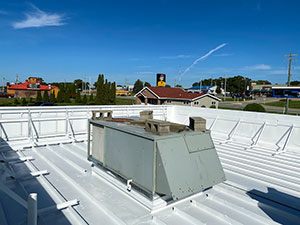
For commercial building owners in Lake Elsinore, CA, maintaining a durable, high-performing roof is essential to protecting assets, operations, and long-term property value. commercial roof restoration is a science-driven solution that extends roof life using advanced materials, coatings, and application methods rather than full replacement. Understanding how restoration systems work helps owners make informed decisions about performance, sustainability, and cost control. To learn more about whether restoration is right for your facility in Lake Elsinore, CA, call 951-609-1818 to speak with the team at Woolbright’s Roofing & Construction.
Understanding the Science of Roof Restoration Systems
Commercial roof restoration is not simply a surface-level fix. It is a multi-step process rooted in material science and building physics. The goal is to restore waterproofing, flexibility, and thermal performance while reinforcing the existing roof assembly.
At the core of most restoration systems are elastomeric or silicone-based coatings. These materials are engineered to expand and contract with temperature changes, preventing cracks that allow moisture intrusion. Their elasticity is measured scientifically to ensure they maintain flexibility over years of sun exposure and thermal cycling.
Another key principle is adhesion chemistry. Restoration coatings are designed to bond at a molecular level to substrates such as metal, TPO, EPDM, or modified bitumen. Proper adhesion ensures the restored roof acts as a unified system rather than layered components prone to separation.

How Commercial Roof Restoration Improves Performance
Moisture Control and Waterproofing
Water infiltration is one of the most destructive forces affecting commercial roofs. Restoration systems seal seams, fasteners, and penetrations, creating a continuous waterproof membrane. This reduces the risk of trapped moisture, which can degrade insulation, corrode metal decking, and weaken structural integrity.
Thermal Reflectivity and Energy Efficiency
Many restoration coatings are formulated with reflective pigments that deflect UV and infrared radiation. From a scientific standpoint, this reduces heat absorption and surface temperatures. Lower roof temperatures can decrease HVAC strain, stabilize indoor conditions, and improve overall building energy performance, especially valuable in sunny climates like Lake Elsinore, CA.
Flexibility and Stress Distribution
Buildings naturally move due to wind loads, temperature shifts, and structural settling. Restoration systems are engineered to absorb and distribute these stresses evenly across the roof surface. This reduces localized cracking and prevents small defects from developing into major failures.
The Role of Preparation and Application Science
A successful commercial roof restoration depends heavily on surface preparation and controlled application. Before any coating is installed, the roof undergoes cleaning, moisture testing, and adhesion testing. These steps are guided by industry standards and material specifications to ensure compatibility.
Surface preparation removes contaminants that could interfere with bonding.
Primers may be applied to enhance chemical adhesion between the existing roof and the restoration system.
Controlled thickness application ensures the coating performs as designed. Too thin, and it may fail prematurely; too thick, and it may cure improperly.
These steps are critical because restoration systems rely on precision, not guesswork. When installed correctly, the restored roof performs as a cohesive system rather than a patchwork of repairs.
Longevity, Sustainability, and Lifecycle Value
From a lifecycle perspective, commercial roof restoration is designed to maximize return on investment. Scientifically tested materials resist UV degradation, ponding water, and environmental pollutants. This slows aging and extends roof service life by many years.
Restoration also supports sustainability goals. By reusing the existing roof structure, building owners reduce landfill waste and minimize the environmental impact associated with tear-offs and replacements. Many restoration systems can be reapplied in the future, further extending roof life through planned maintenance rather than reactive replacement.
For commercial building owners focused on long-term asset management, restoration aligns with predictive maintenance strategies and capital planning models.
Commercial Roof Restoration Experts
In Lake Elsinore, CA, understanding the science behind commercial roof restoration empowers building owners to make smarter decisions about protecting their facilities. Restoration systems combine material engineering, moisture control, and thermal science to deliver durable, efficient roofing solutions. If you’re evaluating the condition of your commercial roof or planning for future performance, contact Woolbright’s Roofing & Construction at 951-609-1818 to discuss restoration options tailored to your building’s needs.
FAQ
What types of commercial roofs can be restored?
Many systems, including metal, single-ply, and modified bitumen roofs, can be restored if the underlying structure is sound.
How does roof restoration differ from roof replacement?
Restoration reinforces and protects the existing roof system, while replacement removes and rebuilds the roof entirely.
Can roof restoration improve energy efficiency?
Yes, reflective coatings can reduce heat absorption and improve overall building energy performance.
Is commercial roof restoration a long-term solution?
When properly installed and maintained, restoration systems can extend roof life significantly and be renewed in future cycles.